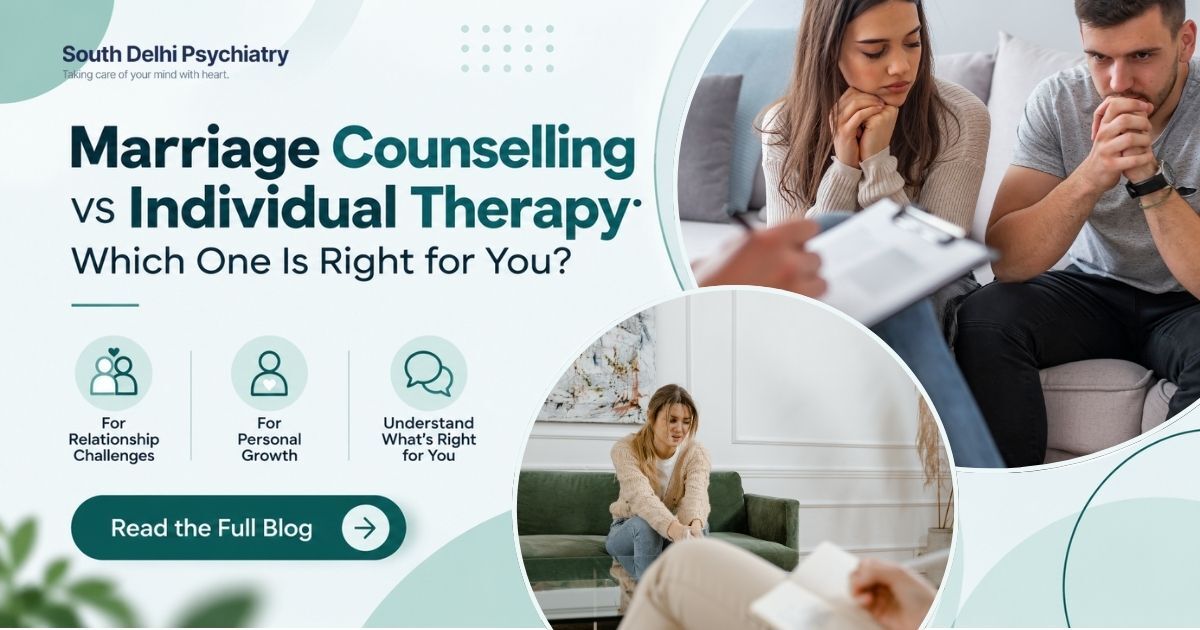
Few people reach this question calmly. It tends to follow an argument that went too far, a long silence at home, or a sense that something inside you has shifted and your relationship is taking strain.
Choosing between marriage counselling and individual therapy comes down to one question. Is the problem mainly between you, or mainly within you? Sometimes the honest answer is both, and that’s fine. Here’s how to work out which route deserves your first step.
Two Rooms, Two Very Different Conversations
Individual therapy is one person and one therapist. The focus is you: your thoughts, your history and your patterns, including the way they show up in your closest relationships. Your partner never enters the room, which gives you space to say things you haven’t yet said aloud.
Marriage counselling works differently. Both partners attend together, and the relationship itself becomes the client. The therapist doesn’t take sides. Instead, they slow down the conversations that spiral at home, so each of you finally hears what the other has been trying to say.
When Marriage Counselling Is the Better Starting Point
Joint sessions suit couples whose difficulties live in the space between them. Think of the same fight repeating every few weeks, trust damaged after an affair, or two people who now feel more like flatmates than partners. Big transitions belong here too, such as a new baby, moving in with parents or one partner relocating for work.
The key condition is willingness. Both of you need to want things to improve, even if you disagree on how. If one partner has already decided to leave, sessions turn into negotiation rather than repair. And where there is abuse or fear of a partner, couples work isn’t appropriate. Individual support and safety come first.
When the Struggle Started Long Before "I Do"
Some relationship strain is really a personal difficulty spilling over. Anxiety that leaves you needing constant reassurance. Low mood that drains your patience. An old hurt that resurfaces whenever you feel criticised. Better communication won’t reach the root of any of these, but individual counselling can.
You work on understanding your own reactions, at your own pace, without managing a partner’s feelings in the same hour. Approaches such as cognitive behavioural therapy (CBT) give you practical tools for catching unhelpful thought patterns before they turn into yet another argument. Your relationship benefits too, because a calmer and clearer version of you comes home each evening.
"My Partner Won't Come" Doesn't Close the Door
Plenty of people stall at this point, and they shouldn’t. Starting therapy alone is a legitimate first move, not a lesser option. You can still work on how you communicate, hold boundaries and respond during conflict. Those changes alter the dynamic at home, whether or not your partner ever joins you.
Persistent depression, panic attacks or poor sleep add another layer to the decision. In those cases, seeing a psychiatrist in South Delhi helps you understand whether medical treatment would support the talking work. At South Delhi Psychiatry in Safdarjung Enclave, the first consultation is about understanding what’s happening before recommending any route.
Start With the Question, Not the Label
You don’t need the answer worked out before you book. Labels matter less than getting the right kind of help at the right time, and a good clinician will tell you plainly if a different format would serve you better. Neither choice locks you in, either. Starting in one format and switching once the picture is clearer is completely normal, so taking the first step matters far more than getting it perfect.
If the hurt sits mostly between the two of you, marriage counselling is the natural place to begin. If it started with you, begin there instead. Book a confidential consultation with South Delhi Psychiatry, in person or online, and talk it through with someone who can help you decide.
FAQs :
How long does marriage counselling usually take?
There’s no fixed length. Some couples notice progress within a handful of sessions, while long-standing issues need more time. Your therapist reviews progress with you regularly, so marriage counselling continues only for as long as it’s genuinely useful.
Can I move from individual therapy to couples sessions later?
Yes. Plenty of people begin alone, gain some clarity, then invite their partner to join. Moving between individual and joint counselling is a normal part of the process, and your therapist can help you judge when the timing suits you both.
Should I see a therapist or a psychiatrist?
A therapist helps you work through thoughts, emotions and patterns in conversation. A psychiatrist in South Delhi is a medical doctor who can diagnose conditions and prescribe medication where needed. Some people benefit from both within a single care plan.
Will my partner find out what I say in individual sessions?
No. Individual sessions are completely confidential, and nothing is shared with your partner without your consent. There are limited exceptions involving serious risk of harm, and your clinician will explain exactly what those are at your very first appointment.
Can I attend sessions online?
Yes, you can. South Delhi Psychiatry offers online consultations alongside in-person appointments at its Safdarjung Enclave clinic. Online sessions suit people with demanding schedules, or anyone who finds it easier to open up from the comfort of home.